
If you live in Dubai, chances are you’ve been added to a WhatsApp group called “Padel Tonight?”.
It starts innocently: a quick after-work match at 7 PM. Before you know it, you’re debating racket shapes and booking courts in Al Quoz at midnight because it’s the only slot available.
Padel has taken over the city from the luxury courts of Jumeirah to the warehouse-style arenas in DIP. It’s social, fast, and addictive.
It’s also the perfect escape after a long day staring at spreadsheets, jumping between Zoom calls, or navigating back-to-back meetings.
But behind the glass courts, there’s a quiet injury epidemic no one is talking about.
Ask any physiotherapist in Dubai what they’re treating right now, and you’ll hear the same thing:
The “Biological Shock”: Why Your 9-to-5 is the Real Opponent
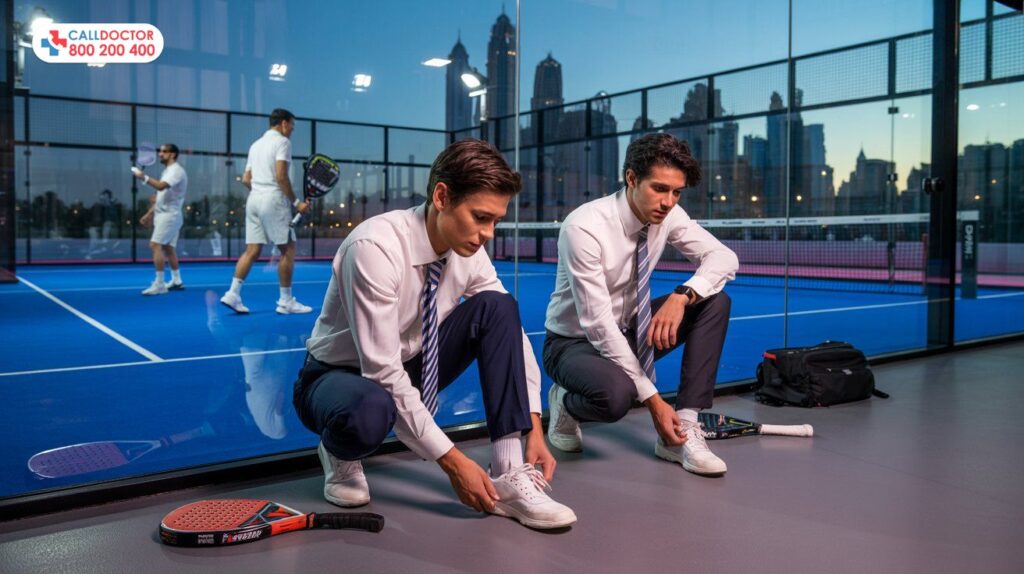
To understand why you got injured, we have to look at what you were doing before you walked onto the court.
Most of us spend our days in a “flexed” position. We sat in traffic on Sheikh Zayed Road. We sit in the boardroom. We sit at our desks.
When you sit for 8+ hours, your body physically adapts to that shape:
- Hip Flexors Shorten: This limits your ability to stride forward for a low ball.
- Glutes Go “Dormant”: Your glutes are your power engine. When you sit on them all day, they “forget” how to fire.
- Thoracic Stiffness: Hunching over a laptop locks up your upper back. In Padel, you need to twist your upper back to hit shots. If your back is locked, your shoulder or lower back takes the hit instead.
Then, you rush to court. You skipped the warm-up because you were stuck in traffic. You sprint for the first ball, and your body which has been “frozen” in a seated shape all day revolts.
The Big Three: Recognizing the Warning Signs
Pain is your body’s check engine light. Ignoring it usually leads to a tear or a chronic condition. Here are the three most common injuries we treat via Physiotherapy at home in Dubai.
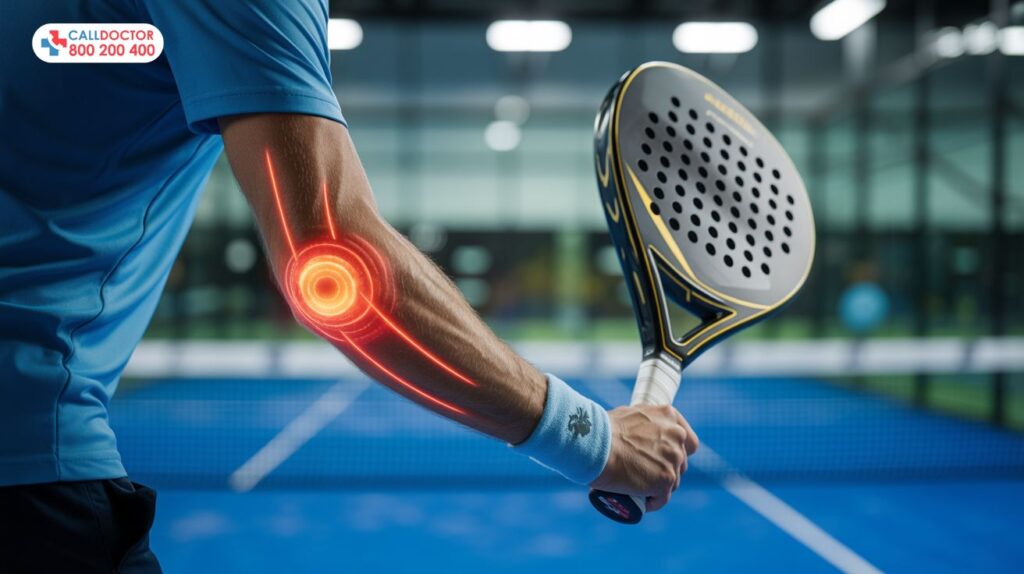
1. Padel Elbow (It’s Not Just Tennis Elbow)
Padel is different from playing tennis. The court is smaller, the ball comes back faster, and you often must use your wrist to generate spin or dig a ball out of a corner.
The Sensation: It starts as a dull ache on the outside of your elbow. Eventually, it becomes a sharp pain when you do simple things, like lifting a coffee cup or turning a doorknob.
The “Hidden” Cause: Often, it’s the racket. Padel rackets are heavy and have no strings to absorb vibration. If your grip is too small (a common mistake), you squeeze the handle too hard, overworking your forearm muscles.
2. The “Glass Wall” Ankle Sprain
The walls are part of the game, but they are also a hazard. Players often track a ball, realize it’s bouncing off the glass, and try to change direction instantly.
The Sensation: A sharp roll of the ankle, followed by immediate swelling or bruising.
The Equipment Factor: Are You Running Shoes? Throw them away. Running shoes are designed to move forward. They have soft, high edges that cause you to roll your ankle during lateral (side-to-side) movements. You need specific court shoes with a herringbone sole.
3. The “Commuter’s Back” (Lumbar Strain)
The smash (or remate) is the glory shot in Padel. It requires you to arch your back and extend it fully.
The Sensation: A catch or spasm in the lower back, often felt after the game when you cool down or drive home.
The Mechanism: Because your hips are tight from sitting all day, they can’t extend. So, your lower back compensates by overarching. You are essentially asking your spine to do a job your hips should be doing.
Pre-Game Protocol: 5 Minutes to Save Your Knees
Let’s be realistic. You probably won’t arrive 30 minutes early to foam roll. But can you spare 5 minutes?
Do this routine right next to the court to “wake up” your desk body:
- Deep Squat to Stand (10 reps): Open up those tight hips.
- Arm Circles & Torso Twists: Lubricate the shoulder joints and upper back.
- High Knees (30 seconds): Get the heart rate up before the first point.
- Shadow Swings: Swing your racket at 50% intensity. Don’t let your first swing of the day be a 100% power smash.
Beyond Ice: Modern Recovery Strategies
If you are already injured, the old advice was R.I.C.E (Rest, Ice, Compress, Elevate). While ice helps with pain, it doesn’t fix the problem.
Modern Padel tennis injury recovery is about active rehabilitation.
Don’t Stop Moving: Complete rest often makes tendons stiffer. You need “optimal loading”—gentle movement that stimulates blood flow without aggravating the injury.
Hydration & Electrolytes: This is Dubai. Even in air-conditioned indoor courts, you sweat significantly. Dehydration leads to muscle cramps and tears.
Soft Tissue Work: Your muscles need to be manually released from the tension accumulated at the desk.
Why Smart Professionals Choose Home Physiotherapy
Here is a scenario you might recognize: You finish work at 6 PM. Your back hurts. You know you need a physio. But the clinic is 20 minutes away, parking is a nightmare, and you’re exhausted. So, skip it.
You skip it again the next week. Three weeks later, your back goes into spasm, and you can’t work or play.
Consistency is the only way to fix musculoskeletal issues.
This is why home physiotherapy in Dubai is shifting from a luxury to a necessity for busy professionals. It removes the friction of “getting there.”
We See Your Setup: A home physio can look at your home office chair or your sofa setup and tell you, “That is why your back hurts.”
Zero Traffic Stress: Stress increases cortisol, which creates muscle tension. Why add traffic stress to your recovery session?
Privacy: You don’t need to be in a crowded waiting room. You can recover in your living room, watch your favorite show, or even take a conference call while getting dry needling on your calf.
Don’t Let Pain Bench You
Padel is the most fun you can have after work — don’t let an easily preventable injury sideline you.
Whether it’s a nagging elbow or a stubborn ankle sprain, Call Doctor brings licensed physiotherapists directly to your home or office.
Fast, convenient, personalized.
We treat the lifestyle, not just the injury.
Book Your Home Physiotherapy Session Now — Expert care, zero traffic, and a faster return to the court.
Frequently Asked Questions (FAQs)
1. Can I play Padel with mild lower back pain?
Not recommended. Rotation-heavy sports can turn “mild” pain into a disc issue. Rest briefly and get a physio to release your hips first.
2. How do I know if it’s Padel Elbow or normal soreness?
Soreness fades in 48 hours.
Padel Elbow causes sharp pain when gripping objects like a coffee cup or steering wheel.
3. Does my racket really affect injury risk?
Yes. “Diamond” rackets are top-heavy and harder on the elbow. Beginners should choose “Round” rackets with soft foam cores.
4. Is physiotherapy at home as effective as going to a clinic?
Absolutely. Our mobile physiotherapists carry treatment tables, dry needling kits, ultrasound devices, resistance bands everything a clinic has.
5. How long is recovery from an ankle sprain?
Grade 1: 1–2 weeks
Grade 2: 4–6 weeks
The key is retraining balance (proprioception) so you don’t re-roll it.
6. Should I use heat or ice?
Ice for the first 48 hours after a new injury.
Heat for chronic stiffness or warming up sore muscles.
7. Can physio be done at my office?
Yes. We see clients during lunch breaks in Downtown, DIFC, JLT, Media City — we just need a small private area.