Bringing a loved one home after a stroke can feel incredibly overwhelming, as the transition from hospital care to home life presents an entirely new set of challenges and uncertainties for the entire family. You are likely asking yourself how you will manage their daily needs, ensure their safety, and help them regain their lost independence. Fortunately, you don’t have to navigate this daunting journey alone, because expert medical support is just a phone call away. With specialized stroke rehabilitation physiotherapy in Dubai available right at your doorstep, you can transform your home into a safe, healing environment. Here is a comprehensive family guide on when to start home therapy and how it effectively accelerates recovery.
Why is the Home Environment Crucial for Stroke Recovery?
When discussing stroke rehabilitation, many people envision sterile hospital gyms filled with complex equipment. However, an emerging consensus among neuro-physiotherapists highlights a powerful concept known as “context-dependent learning.” Essentially, relearning how to walk across your own living room rug, navigating your own bathroom, or sitting up in your own bed is neurologically far more effective than practicing these same skills in an unfamiliar clinical setting.
Your brain relies on familiarity to heal. This process, called neuroplasticity, the brain’s ability to rewire itself and form new neural connections after an injury is highly sensitive to the environment.
Hospitals can often induce anxiety, which creates a high cognitive load that distracts the brain from focusing on motor recovery. At home, the stroke survivor is surrounded by familiar faces, comforting smells, and personal routines. This significantly lowers stress hormones like cortisol, allowing the brain to direct its energy entirely toward physical and cognitive healing.
Furthermore, home care services allow the rehabilitation to be inherently practical. The challenges a patient faces in their daily life become the exact focus of their therapy. Instead of practicing on a perfectly flat clinical floor, they learn to navigate the specific layout of their own home, which builds genuine confidence and reduces the risk of falls in the long run.
When Should You Transition from Hospital to Home Physiotherapy?
A critical question every family asks is: When is the right time to move from hospital-based care to home physiotherapy?
The primary indicator for transitioning home is medical stability. Once the acute phase of the stroke has passed and the patient’s vital signs are stable, the focus shifts entirely to rehabilitation.
Neurologists and physiotherapists often refer to the first three to six months following a stroke as the “Golden Window” of recovery. During this period, the brain is in a heightened state of plasticity, making it exceptionally receptive to relearning lost skills and rewiring damaged neural pathways.
Transitioning to stroke rehabilitation physiotherapy in Dubai as soon as the patient returns home is crucial to capitalize on this Golden Window. Delaying therapy can lead to muscle atrophy (wasting away muscles), severe joint stiffness, and the development of abnormal movement patterns that become incredibly difficult to correct later. Early intervention at home ensures that recovery momentum is never lost. It bridges the gap between hospital discharge and long-term independence, providing continuous, uninterrupted care that is vital for optimal recovery outcomes.
How Does a Customized Stroke Rehabilitation Plan Work at Home?
No two strokes are identical; therefore, no two recovery journeys will be exactly the same. A stroke can affect the right side of the brain in one patient, impairing left-sided movement and spatial awareness, while affecting the left side in another, causing speech and language difficulties.
Because of this immense variability, a cookie-cutter approach to therapy is ineffective. When you hire DHA-licensed professionals for home physiotherapy, the process is meticulously customized to the individual’s unique neurological deficits.
The Initial Comprehensive Assessment
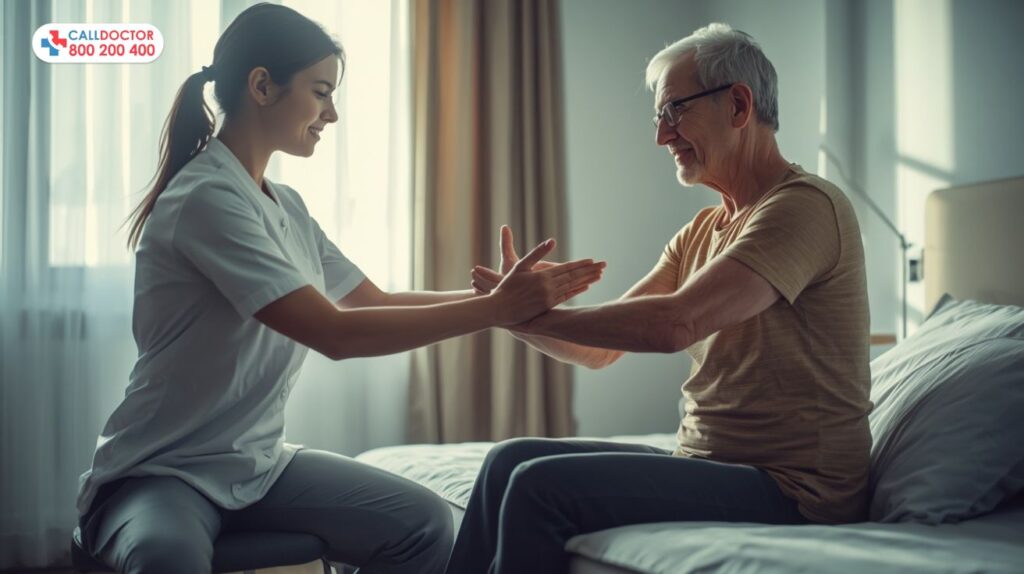
The first step involves a deep, comprehensive evaluation. The physiotherapist will assess the patient’s current mobility, balance, muscle tone, and coordination. They will also evaluate the home environment to identify any immediate safety risks. This assessment establishes a baseline from which all future progress will be measured.
Setting Realistic, Phased Goals
Stroke recovery can seem like an insurmountable mountain. A skilled physiotherapist will break this mountain down into manageable, phased goals. Short-term goals might include learning to transition safely from a lying to a sitting position, or being able to stand independently for thirty seconds. Long-term goals are broader, such as walking unassisted to the kitchen, regaining full arm function for feeding, or safely using the stairs.
A Multidisciplinary Approach
While physiotherapy focuses heavily on motor function and mobility, stroke recovery is often multidisciplinary. The physiotherapist will frequently collaborate with occupational therapists, who focus on fine motor skills and the activities of daily living (like buttoning a shirt or holding a fork), and speech therapists, who address swallowing difficulties and language impairments. This holistic approach ensures that every aspect of the patient’s independence is actively being restored.
How Do Physiotherapists Help Regain Motor Function and Balance?
The core of stroke rehabilitation physiotherapy involves specific, evidence-based physical interventions designed to stimulate the brain and strengthen the body. Overcoming paralysis or significant weakness requires dedication, repetition, and expert guidance.
Neuro-Muscular Re-education and Gait Training
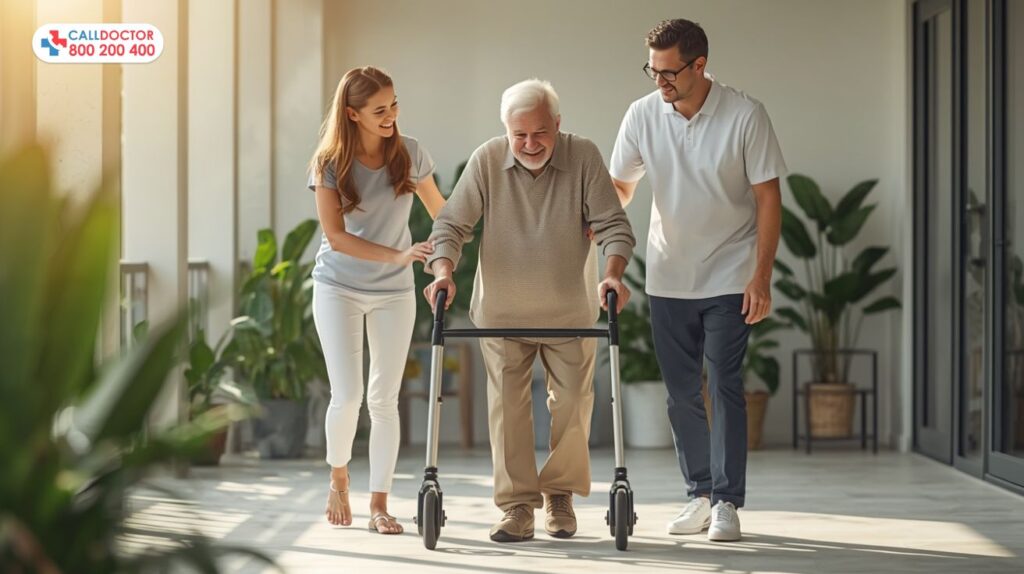
One of the primary goals is helping the patient walk again a process known as gait training. Physiotherapists use neuro-muscular re-education techniques to teach the brain how to recruit the correct muscles in the correct sequence. This often starts with simple weight-bearing exercises while standing, progressing to stepping in place, and eventually walking with mobility aids before transitioning to independent walking.
Constraint-Induced Movement Therapy (CIMT)
For patients with hemiparesis (weakness on one side of the body), a highly effective technique called Constraint-Induced Movement Therapy (CIMT) may be used. This involves temporarily restricting the use of the unaffected, strong limb (often with a mitt or sling), forcing the brain to rely on and actively rewire connections to the weaker, affected limb. While intense, CIMT is proven to yield significant improvements in motor function.
Managing Spasticity and Core Strengthening
After a stroke, many patients develop spasticity a condition where muscles become abnormally stiff, tight, and resistant to stretching. Physiotherapists employ specialized stretching techniques and joint mobilizations to relieve this stiffness, preventing painful contractures. Furthermore, core strengthening is a massive component of home therapy. A strong core is the foundation of all movement; without core stability, a patient cannot safely sit up, stand, or walk without losing their balance.
Why is Family Involvement the Secret to Faster Recovery?
While professional physiotherapy is non-negotiable, the unsung heroes of stroke recovery are the family members. Families are not just passive observers; they are active, vital participants in the rehabilitation process.
A physiotherapist may visit the home for an hour a day, a few times a week. However, neuroplasticity requires consistent, daily repetition. Family members are taught how to safely assist the patient with “homework” exercises between official sessions. By integrating these exercises into the patient’s daily routine, families effectively multiply the impact of the therapy.
Furthermore, the emotional support provided by the family cannot be overstated. Stroke recovery is incredibly taxing on the patient’s mental health. A supportive family environment acts as a buffer against depression and loss of motivation.
“Recovery doesn’t stop when the physiotherapist leaves the house. A family’s daily encouragement, patience, and assistance with prescribed exercises is the true engine that drives a patient’s neuroplasticity, building both physical strength and unwavering confidence.” — Call Doctor Rehabilitation Expert
What Unexpected Challenges Might Families Face During Recovery?
To navigate stroke recovery successfully, families must go in with realistic expectations. The road to recovery is rarely a straight, upward trajectory; it is filled with peaks, valleys, and plateaus. Being prepared for these unexpected challenges is crucial for maintaining hope and resilience.
The Plateau Effect
Perhaps the most frustrating phase of recovery is the “plateau effect.” During the first few months, progress can seem rapid and exciting. However, there often comes a time when visible improvements slow down drastically. Families may panic; assuming recovery has completely stopped. Physiotherapists help families understand that plateaus are a normal part of brain healing. The brain is consolidating what it has learned before preparing the next leap in function. Persistence during a plateau is critical.
Post-Stroke Fatigue
Families are often surprised by the sheer level of exhaustion the stroke survivor experiences. Post-stroke fatigue is completely different from normal tiredness. Because the brain is working overtime to reroute signals around damaged tissue, even simple tasks like eating or having a conversation can leave the patient completely drained. Families must learn to pace activities and allow for significant periods of restorative rest without viewing it as laziness or a lack of motivation.
Emotional Swings and Frustration
Damage to the brain can chemically alter a person’s mood, leading to conditions like emotional lability (uncontrollable crying or laughing) and post-stroke depression. Compounded by the frustration of losing independence, the patient may lash out or become deeply withdrawn.
Recognizing these emotional changes as symptoms of the stroke rather than personal failings helps families respond with empathy and seek appropriate psychological support if necessary.
How to Create a Safe Space for Stroke Patients at Home?
Before the patient even arrives home from the hospital, the physical environment must be adapted to ensure their absolute safety. The goal is to minimize the risk of falls and make navigation as effortless as possible. A home healthcare team will often assist families in auditing their homes, but here is a fundamental checklist to get started:
- Eliminate Tripping Hazards: Remove all loose rugs, electrical cords, and clutter from walkways. Tape down the edges of carpets if they cannot be removed.
- Bathroom Modifications: The bathroom is the most dangerous room in the house. Install sturdy grab bars near the toilet and inside the shower. Consider a raised toilet seat, a shower chair, and non-slip mats to prevent catastrophic falls on wet tiles.
- Optimize Lighting: Ensure that all hallways, staircases, and the path from the bedroom to the bathroom are brightly lit. Consider installing motion-sensor nightlights to assist the patient during nighttime bathroom visits.
- Furniture Arrangement: Rearrange living room and bedroom furniture to create wide, clear pathways. Ensure there is ample space to maneuver a walker or a wheelchair without constantly bumping into obstacles.
- Accessible Essentials: Place everyday items like remote controls, water glasses, medications, and telephones within easy reach so the patient doesn’t have to stretch or bend dangerously to retrieve them.
Conclusion: Partnering with Call Doctor for Your Recovery Journey
Recovering from a stroke is undeniably one of the most profound challenges a family can face. It requires immense patience, unwavering dedication, and the right medical expertise. While the journey is long, the transition back to a meaningful, independent life is entirely possible.
By choosing specialized stroke rehabilitation physiotherapy in Dubai, you are giving your loved one the ultimate advantage: the ability to heal in the comfort, safety, and dignity of their own home. Context-dependent learning, combined with early intervention and deep family involvement, creates an environment where neuroplasticity can truly thrive.
You do not have to carry this burden alone. The DHA-licensed experts at Call Doctor are ready to partner with you, providing comprehensive, compassionate, and highly customized physiotherapy tailored to your family’s unique needs. To take the first vital step toward recovery, contact Call Doctor today to schedule an initial in-home assessment, and let us help you build a stronger, brighter future together.