

Quick Summary:
When administered by licensed healthcare professionals under Dubai Health Authority (DHA) protocols, intravenous micronutrient therapy has an established clinical track record. However, because it bypasses digestive barriers and introduces fluids directly into your bloodstream, it carries tangible medical risks if mismanaged. This guide outlines verified side effects, clinical contraindications, and regulatory standards to help you determine whether treatment is safe for your body.
Intravenous (IV) vitamin infusions have transitioned from hospital emergency rooms to residences and luxury hotels across the United Arab Emirates. People seek them out for rapid hydration in the desert climate, quick relief from jet lag, or an immune boost during demanding work routines. But bypass absorption wellness is still a medical procedure. If you are asking is IV therapy safe, Dubai residents and visitors can rest assured: it is generally safe when performed under strict clinical governance. However, delivering concentrated nutrients straight into systemic circulation carries physiological consequences that require proper medical oversight.
Why Has IV Vitamin Therapy Become So Popular in Dubai?
In conventional nutrition, every nutrient you swallow passes through the gastrointestinal tract. Stomach acid, digestive enzymes, and first pass metabolism in the liver restrict how much of any vitamin or mineral actually reaches cellular receptors. For instance, high dose oral ascorbic acid (Vitamin C) typically hits an intestinal absorption ceiling of roughly 18% to 20% due to transporter saturation.
By contrast, an intravenous infusion introduces fluids, electrolytes, and water-soluble vitamins straight into a peripheral vein. This bypasses gastrointestinal barriers entirely to achieve 100% systemic bioavailability.
In Dubai, several environmental and lifestyle factors drive demand for customized IV drip therapy:
- Extreme Climatic Dehydration: Prolonged exposure to high ambient temperatures and rapid transitions between summer heat and air conditioned buildings deplete intracellular water and electrolytes.
- Demanding Executive Schedules: Busy work routines often leave little time for optimal dietary planning, leading to chronic micronutrient fatigue.
- Frequent International Travel: Frequent flyers passing through Dubai International Airport (DXB) frequently turn to intravenous rehydration to mitigate circadian rhythm disruption, oxidative stress, and cabin air dehydration.
Yet, higher bioavailability does not automatically mean higher health benefits. The human body maintains strict homeostatic equilibrium. Excess water soluble compounds like Vitamin C or B-complex vitamins that exceed your cellular demands are processed by the liver and excreted through the renal system. Understanding this balance is the first step toward approaching the treatment with realistic expectations.
How Safe Is IV Therapy When Administered at Home or in a Clinic?
The fundamental safety of any intravenous drip does not depend solely on the physical setting whether in a clinical treatment room, a private villa, or a hotel suite. Safety depends on aseptic technique, pharmaceutical purity, patient health screening, and emergency readiness.
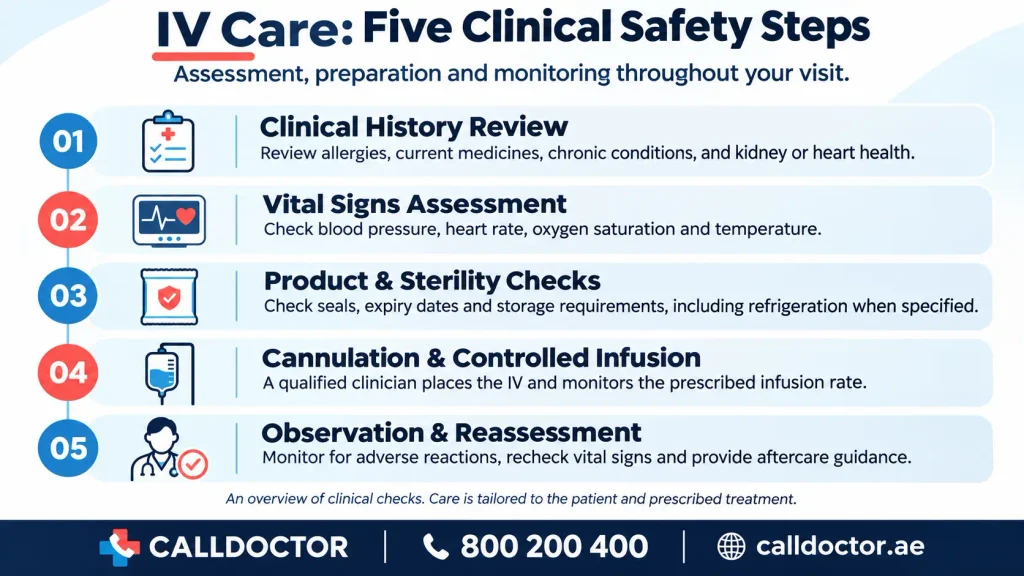
When delivered by a reputable doctor on call service, receiving an infusion at home adheres to the same clinical standards observed in hospitals. A licensed clinician arrives with single use, sterile consumables, inspects the seal on every vial in front of the patient, and completes a baseline health assessment before introducing a cannula.
How Does the Dubai Health Authority (DHA) Regulate IV Infusions?
The Dubai Health Authority enforces strict standards for elective and supportive treatments. These regulations exist specifically to prevent unqualified operators from offering invasive treatments without clinical oversight:
- Mandatory Licensure: Only DHA licensed Registered Nurses (RNs) and board certified medical doctors are legally permitted to prescribe, prepare, and administer intravenous infusions.
- Pharmaceutical Cold Chain Governance: Active vitamins like Glutathione, Methyl cobalamin (B12), and Ascorbic Acid degrade when exposed to heat and sunlight. Providers must transport these compounds in validated, temperature controlled medical cool boxes kept between 2°C and 8°C.
- Clinical Triage Documentation: Regulated providers cannot insert a needle without recording objective baseline vitals: systolic and diastolic blood pressure, pulse, peripheral oxygen saturation (SpO2), and clinical screening notes.
What Are the Most Common IV Drip Side Affects You Might Experience?
Most adverse reactions to intravenous infusions are mild, localized, and resolved on their own. These side effects stem from the physical act of needle insertion or the rapid introduction of fluids into peripheral vessels.
| Common Side Effect | Underlying Cause | Typical Duration | Clinical Management |
| Localized Bruising (Hematoma) | Minor blood leakage into subcutaneous tissue after cannula removal | 2 to 5 days | Cold compress and gentle localized pressure |
| Cool Sensation in the Arm | Infusion fluid entering a 37°C body at room or cool storage temperature | While infusion runs | Adjusting flow rate; warming the arm with a blanket |
| Metallic or Vitamin Taste | Rapid distribution of B-complex vitamins and Zinc passing lingual receptors | 5 to 15 minutes | Chewing mints or sipping drinking water |
| Mild Post Drip Lightheadedness | Transient vasovagal reflex or fluid volume shifts altering vascular tone | 10 to 30 minutes | Remaining seated; elevating the lower extremities |
Why Do Some People Feel Lightheaded, Chilled, or Taste Metal?
During an infusion, high concentrations of water soluble solutes travel past your salivary glands within 60 to 90 seconds. This frequently causes a sudden metallic or distinct vitamin taste at the back of the mouth. While startling, this reaction is entirely harmless and confirms active vascular transport.
Similarly, feeling chilled in your arm or shoulder happens because the infusion fluid bag is typically cooler than your normal core body temperature (37°C). The temperature difference triggers localized vasoconstriction. If this causes discomfort, the clinician simply slows the infusion rate to allow surrounding venous blood to warm the mixture.
When Does Localized Vein Irritation (Phlebitis) Occur?
Chemical phlebitis refers to inflammation of the inner lining (tunica intima) of the targeted vein. It presents localized warmth, erythema (redness), tenderness, or mild cord like firmness along the vein path.
Phlebitis generally occurs when:
- Highly acidic solutions (such as concentrated Vitamin C) are infused without enough carrier fluid.
- Hypertonic solutions with high mineral osmolarity draw water out of endothelial cells too quickly.
- The cannula shifts slightly against the vascular wall during patient movement.
A DHA certified nurse prevents this by matching cannula gauge to vein caliber, choosing appropriate dilution volumes in 0.9% Normal Saline or Ringer’s Lactate, and monitoring the site throughout the session.
What Are the Serious IV Therapy Risks Every Patient Must Know?
While minor side effects are manageable, deeper IV therapy risks arise when treatments are carried out without reviewing a patient’s medical history or adjusting the drip rate. An intravenous line bypasses all protective gastrointestinal checkpoints, placing compounds directly into circulation.
How Can Rapid Infusion Cause Fluid Overload or Heart Strain?
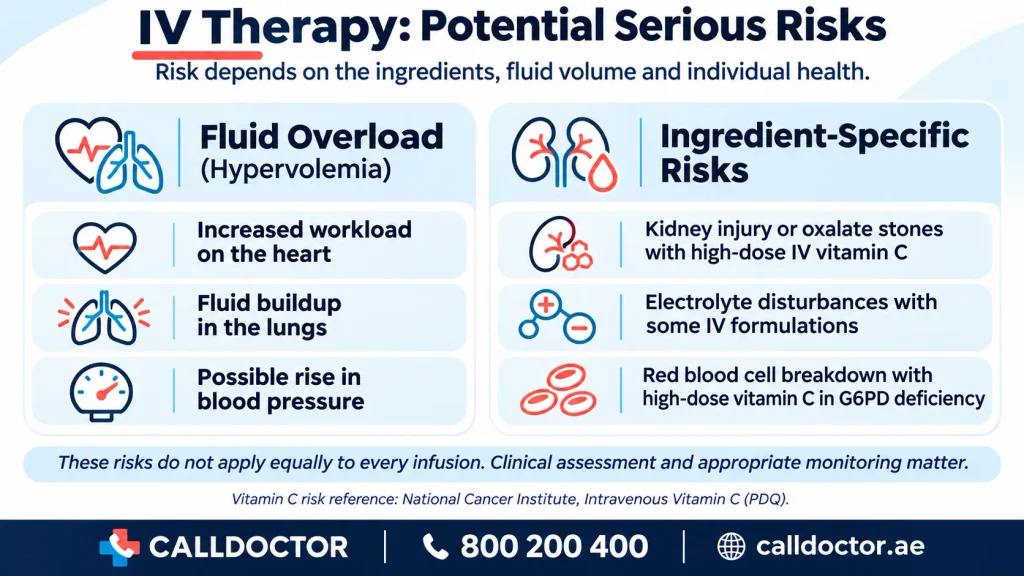
Administering 500 mL to 1,000 mL of fluid into the venous system increases circulating blood volume (hypervolemia). In a healthy individual with normal cardiac function, the kidneys quickly excrete excess fluid volume.
However, in individuals with borderline or diagnosed cardiac dysfunction, a sudden increase in preload can strain the left ventricle. If an infusion runs too quickly, the cardiovascular system can struggle to distribute the volume, resulting in:
- Sharp elevations in arterial blood pressure.
- Shortness of breath (dyspnea) caused by early pulmonary congestion.
- Peripheral edema in the ankles and lower extremities.
To manage this risk, mobile clinicians calculate drip rates by hand or use micro drip chambers, ensuring the solution infuses gradually over 45 to 60 minutes rather than as a rapid bolus.
Why Can High Dose Vitamins Overwhelm Your Kidneys and Liver?
Your kidneys filter blood and regulate electrolyte levels. When an IV introduces high doses of vitamins, your kidneys must work to process the excess:
- Oxalate Accumulation: High doses of intravenous Vitamin C metabolize into oxalate in the bloodstream. In patients with compromised renal function or a history of calcium oxalate kidney stones, this surge can cause nephrolithiasis or direct tubular damage.
- Electrolyte Imbalances: Uncontrolled infusions containing potassium or magnesium can disrupt cardiac rhythms if the recipient’s baseline levels are already elevated.
- Hepatic Strain: While antioxidants like Glutathione support cellular detoxification pathways, the liver still has to process every compound introduced into the body. Unregulated doses given without breaks can strain hepatic enzymes.
“An IV infusion is an invasive clinical procedure, not a casual lifestyle service. The difference between a safe, restorative treatment and a medical emergency comes down to proper patient triage, verified baseline vitals, and licensed medical oversight.” — Clinical Advisory Team, Call Doctor Home Healthcare
Who Should Not Get an IV Drip? (Critical Medical Contraindications)
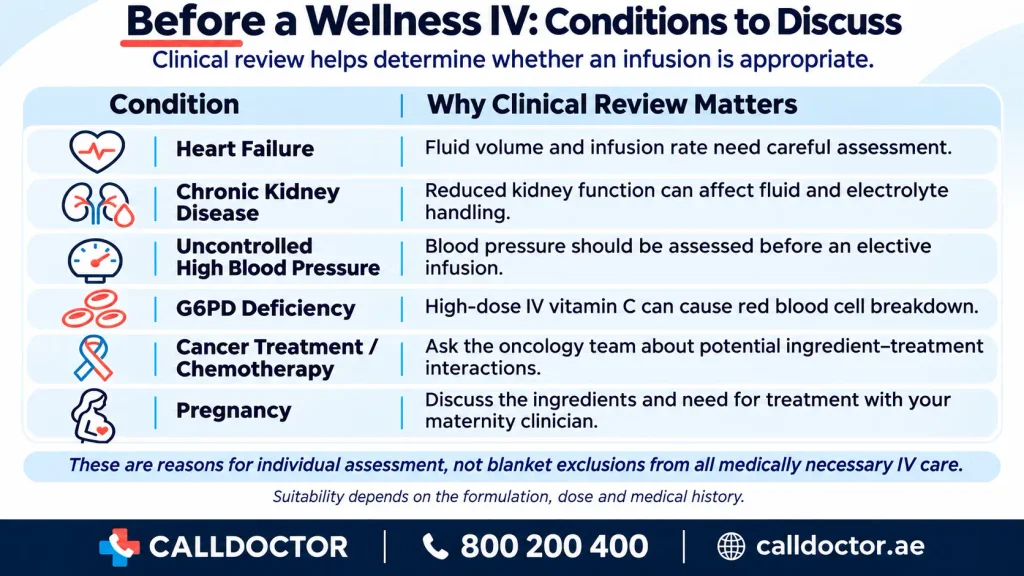
A responsible medical provider’s most important responsibility is knowing when to say no. Qualified clinical teams rely on a clear contraindication checklist to protect patients:
Why Is G6PD Deficiency a Strict Danger for High Dose Vitamin C?
Glucose 6 Phosphate Dehydrogenase (G6PD) deficiency is an inherited genetic enzyme defect found across Mediterranean, Middle Eastern, and African populations.
When high concentrations of ascorbic acid enter the blood, they interact with transition metals to produce trace amounts of hydrogen peroxide (H2o2 ). Normal red blood cells use G6PD to create NADPH, which keeps glutathione reduced and neutralizes oxidative stress.
Red blood cells lacking adequate G6PD cannot neutralize this oxidative burst. The cell membrane becomes fragile and ruptures, leading to acute hemolytic anemia. This breakdown releases free hemoglobin into plasma, causing dark urine, fatigue, jaundice, and potential acute kidney injury.
For this reason, high dose Vitamin C infusions must never be administered without confirming normal G6PD status or having a physician review past blood work.
Why Must Patients with Heart, Kidney, or Blood Pressure Conditions Abstain?
Individuals with systemic organ conditions are the most vulnerable to adverse events:
- Cardiovascular Disease: Patients with cardiomyopathy or heart failure cannot easily manage sudden shifts in intravascular volume.
- Renal Impairment: Anyone with a glomerular filtration rate (GFR) below 60 mL/min/1.73m² will struggle to filter electrolytes and vitamin metabolites, increasing the risk of hyperkalemia (high potassium) or hypermagnesemia (high magnesium).
- Severe Hypertension: Pumping fluid into an already constricted arterial system can cause sudden spikes in blood pressure.
- Expecting or Nursing Mothers: Unless an obstetrician issues a direct prescription for specific rehydration fluids to treat conditions like hyperemesis gravidarum, elective vitamin megadoses are unsafe during pregnancy.
How Can You Tell If an IV Provider in Dubai Is Operating Safely?
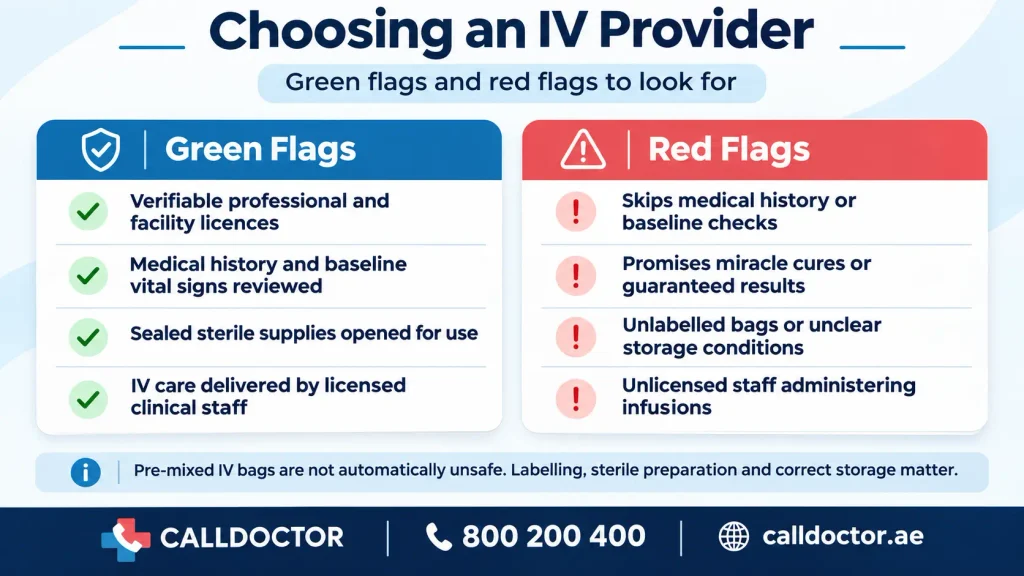
Because medical care is so accessible in Dubai, patients need to know how to distinguish legitimate healthcare providers from substandard operators who treat infusions like consumer beauty products.
The 6-Point Patient Safety Checklist Before You Let a Needle In
Before allowing any visiting practitioner to insert a cannula, confirm every step on this checklist:
- DHA Clinical Identification: Does the practitioner have a valid, active Dubai Health Authority medical license card? (You have every right to ask to see it).
- Baseline Triage: Does the nurse measure and record your blood pressure, heart rate, and oxygen saturation before opening the medication box?
- Targeted Medical History: Did the service ask about your chronic conditions, routine prescriptions, and known allergies?
- Intact Sterile Packaging: Are the tourniquets, skin cleansing chlorhexidine swabs, IV cannulas, and tubing removed from factory sealed, single use packaging right in front of you?
- Temperature Controlled Transport: Did the vitamin vials arrive in an insulated clinical transport container rather than a standard bag?
- Presence of a Medical Director: Does the provider operate under the supervision of a licensed doctor who can be reached if you experience an unexpected reaction?
“If a service is willing to administer an IV drip without checking your blood pressure or reviewing your health history, they are bypassing foundational safety standards. Clinical pre-screening is your strongest protection against complications.” — Clinical Quality Manager, Mobile Healthcare Services
Frequently Asked Questions
Can you experience an allergic reaction to an IV drip?
Yes. While true allergies to basic saline and standard vitamins are uncommon, patients can be allergic to preservatives, complex mineral compounds, or carrier bases in the solution. Symptoms include localized hives, skin flushing, itching, or, in rare cases, respiratory tightness. A qualified nurse will carry an emergency anaphylaxis kit to manage unexpected allergic reactions immediately.
What should you do if your arm hurts after the nurse leaves?
Mild soreness at the puncture site is normal and usually settles within 24 to 48 hours. However, if you notice spreading redness, heat, swelling, or throbbing pain along the vein, contact your healthcare provider right away. These signs can point to localized inflammation (phlebitis) or an early infection that requires clinical evaluation.
How often is it safe to receive an IV drip?
Elective IV therapy is not meant to replace daily hydration or a balanced diet. For general wellness support, most healthy adults should not receive infusions more often than once every two to four weeks. Frequent, repeated cannulation can cause cumulative vein scarring (sclerosis) and place an unnecessary clearance load on your kidneys.
Is an in-home IV drip as safe as one in a hospital?
Yes, the service is delivered by a DHA licensed home healthcare organization. Licensed clinicians use the same hospital grade sterile cannulas, pharmaceutical solutions, and clinical protocols in your home as they would in an outpatient hospital setting.
When to Choose Safety Over Convenience
Intravenous therapy can be an effective way to restore hydration, recover from travel fatigue, and replenish essential micronutrients providing your body can safely handle the treatment.
Before booking any treatment, look past aesthetic promises and verify that the provider follows genuine clinical standards. A reputable healthcare organization will happily review their safety protocols, check your vital signs, and decline to treat you if an infusion is not medically appropriate for your health history.
If you are exploring intravenous hydration or supportive wellness therapy, speak with a licensed clinician first. Prioritize your long term health by scheduling a comprehensive evaluation with a DHA licensed Doctor on Call to ensure every treatment is tailored safely to your body.