
Quick Summary:
While both in-clinic wellness lounges and mobile home healthcare deliver identical pharmaceutical-grade micronutrients directly into the bloodstream, they offer vastly different recovery environments. This clinical guide compares safety protocols, Dubai Health Authority (DHA) standards, privacy, and physiological recovery to help you determine whether an in-clinic visit or an at-home infusion best fits your health needs.
Choosing between an aesthetic wellness lounge and a bedside medical visit is more than a question of convenience. In Dubai, intravenous infusion therapy has evolved from a hospital-bound emergency intervention into an everyday health and recovery tool.
Yet, when acute dehydration, travel exhaustion, or low energy sets in, the friction of daily life often clashes with clinical recovery. Sitting through traffic along Sheikh Zayed Road to visit a clinical lounge yields a completely different physiological outcome than receiving treatment in your own bedroom.
This comprehensive guide analyzes the critical trade-offs between home IV therapy vs IV clinic Dubai setups, giving you the clinical and practical insights needed to make the right choice for your body.
Why Has IV Drip Therapy Become Essential in Dubai?
Intravenous therapy delivers isotonic fluids, essential minerals, vitamins, and amino acids directly into the venous system. By bypassing the digestive tract completely, IV administration ensures 100% cellular bioavailability. This delivers immediate physiological support compared to oral vitamins, which often lose up to 50% to 80% of their potency during hepatic first-pass metabolism and gastrointestinal breakdown.
In the United Arab Emirates, specific environmental and lifestyle variables drive sustained clinical demand for intravenous replenishment:
- Extreme Climate & Rapid Dehydration: High ambient temperatures combined with dehumidified indoor air conditioning accelerate insensible water and electrolyte loss, frequently leading to subclinical dehydration, brain fog, and muscle fatigue.
- Intense Corporate Demands: Professionals across the DIFC, Downtown Dubai, and Business Bay regularly face chronic fatigue, irregular sleep patterns, and elevated oxidative stress.
- Global Travel Hub Realities: As a primary international transit hub via Dubai International Airport (DXB), thousands of residents and visitors experience disruptive circadian shifts, acute jet lag, and severe fluid shifts caused by pressurized cabin air.
While the clinical formulations ranging from normal saline (0.9% NaCl) and Lactated Ringer’s to high-dose ascorbic acid, glutathione, and NAD+ remain consistent across settings, where you receive your infusion fundamentally dictates how effectively your body recovers.
What Happens During an In-Clinic IV Lounge Session?
Visiting a dedicated medical clinic or wellness lounge is the traditional route for intravenous infusions. These facilities range from clinical outpatient centers in Dubai Healthcare City (DHCC) to luxury aesthetic lounges situated in prime retail and lifestyle destinations.
The In-Clinic Patient Workflow
| Stage | Clinic Procedure | Patient Experience & Physical Demand |
| Step 1: Commute & Arrival | Travel to clinic facility | Requires driving through city traffic, finding parking, and walking to the clinic |
| Step 2: Check-In & Triage | Registration desk & waiting lounge | Sitting in a public reception area; initial nurse vitals check |
| Step 3: Administration | Placement in lounge recliner | Vein cannulation and drip setup alongside other patients or in treatment bays |
| Step 4: Completion & Exit | Line removal & billing | Standing up immediately post-drip, settling administration, and driving home |
The In-Clinic Advantages
- Immediate Access to Broader Diagnostic Facilities: Physical medical clinics house diagnostic laboratories and advanced screening equipment. If an infusion is part of a wider diagnostic workup requiring comprehensive pathology panels, full blood counts, or ultrasound imaging, visiting a multi-specialty medical center allows everything to happen under one roof.
- Social and Communal Atmosphere: Modern wellness lounges in Dubai often design their spaces around social wellness, featuring communal seating, modern interiors, and curated beverage menus for friends receiving wellness drips together as part of an outing.
- Structured Clinical Setting: Some patients feel a psychological sense of security inside a traditional clinical facility with administrative desks, multiple consulting suites, and multi-room layouts.
The In-Clinic Trade-Offs
- The Commute Penalty: Traveling across Dubai when dealing with acute migraines, food-borne nausea, or heat exhaustion is physically taxing. Finding parking, walking across multi-level garages, and sitting in traffic while feeling unwell directly counteracts recovery.
- Pathogen Exposure in Waiting Rooms: Outpatient waiting rooms are shared environments. Sitting near patients seeking care for contagious respiratory illnesses introduces avoidable viral and bacterial exposure when your immune system is already compromised.
- Sensory Overload & Lack of Rest: Clinical lounges feature bright lighting, staff movement, and ambient noise. Once the infusion finishes, you cannot lie back and sleep; you must pay your bill, retrieve your vehicle, and navigate the drive home.
How Does Mobile IV Therapy Work in Your Home or Hotel?
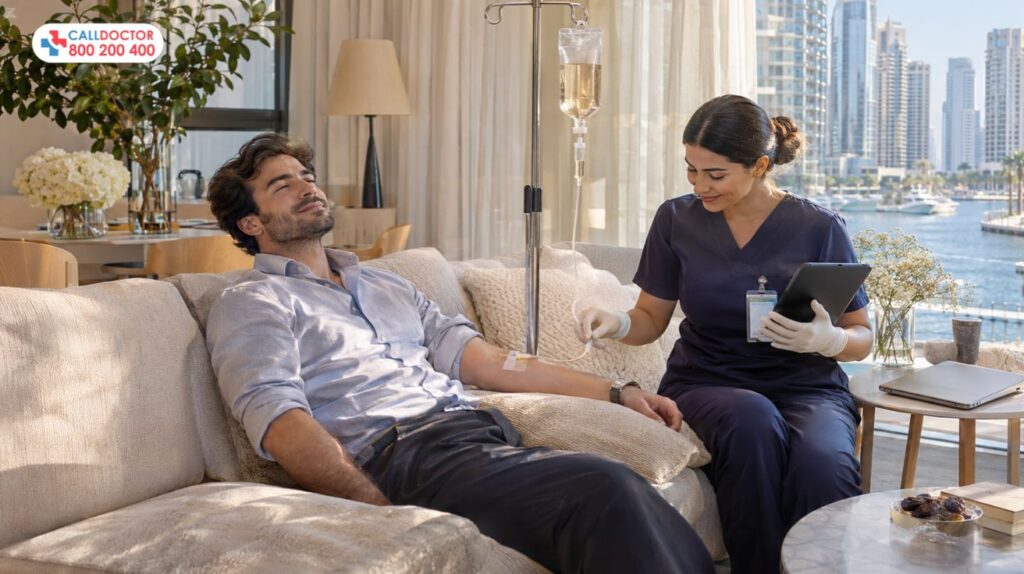
Mobile IV therapy dubai reimagines clinical administration by turning your private residence, hotel suite, or office into a fully equipped, one-on-one medical recovery room.
Rather than traveling to a healthcare facility, a certified medical team arrives directly at your location equipped with medical-grade equipment, cold-chain transport units, and sterile administration kits.
The Mobile Home Care Workflow
| Stage | Bedside Procedure | Patient Experience & Physical Demand |
| Step 1: Dispatch & Arrival | Nurse travels to your location | You remain resting in bed, on your sofa, or at your hotel desk |
| Step 2: Bedside Assessment | Vital signs & clinical intake | One-on-one check of blood pressure, pulse, oxygen levels, and health history |
| Step 3: Sterile Administration | Aseptic bedside cannulation | Single-use sterile infusion setup while you recline in total comfort |
| Step 4: Continuous Monitoring | Dedicated 1:1 nurse oversight | Continuous bedside monitoring; option to nap or work without disturbance |
| Step 5: Pack-Down & Rest | Safe sharps removal & disposal | Medical team departs quietly, leaving you to continue sleeping or resting |
The At-Home Advantages
- Zero Travel Friction: When physical energy is depleted, staying stationary is the most restorative clinical choice. There is no need to dress up, battle traffic, or sit upright in a public lobby.
- Complete Discretion and Privacy: High-profile executives, public figures, busy parents, and hotel guests often prioritize medical confidentiality. At-home therapy eliminates public check-ins, allowing treatment to occur behind closed doors.
- Continuous, Dedicated 1-on-1 Nursing: In a busy clinic, an infusion nurse frequently divides attention across several patients in multiple treatment chairs. With a dedicated home nursing service, a single nurse remains at your bedside throughout the entire 30- to 60-minute infusion, monitoring flow rates, site comfort, and systemic reactions without interruption.
- Immediate Post-Infusion Sleep: Cellular uptake of fluids and electrolytes is most efficient when the body is in a parasympathetic state. At home, you can recline on your couch or fall straight asleep in your bed while the drip runs, remaining asleep long after the nurse leaves.
The At-Home Trade-Offs
- Scheduling Coordination: Mobile services operate with dispatch windows. While emergency teams aim for rapid transit, booking requires a brief window for the medical team to reach your location in communities like Dubai Marina, Palm Jumeirah, or Arabian Ranches.
- Focused Treatment Scope: Mobile visits are designed for acute symptom management, wellness, and targeted replenishment. They cannot replace emergency room interventions, imaging suites, or critical-care cardiac units.
How Do Clinical Safety and DHA Protocols Compare Between Both Settings?
A common misconception is that receiving an infusion at home involves compromises in clinical sterility or procedural safety. In the Emirate of Dubai, this is factually incorrect.
The Dubai Health Authority (DHA) enforces some of the world’s strictest home healthcare licensing standards. Whether administered in a five-star clinic or at your bedside, intravenous cannulation is classified as an invasive medical procedure governed by identical federal mandates.
DHA Mobile Clinical Safety Standards
| Standard | Mobile Home Protocol | Clinical Objective |
| Staff Credentialing | Certified, DHA-registered nurses only | Verifies professional training in peripheral vascular cannulation and emergency response |
| Cold-Chain Transit | Validated medical cooler units (2°C – 8°C) | Prevents thermal degradation and chemical oxidation of active vitamins and antioxidants |
| Aseptic Field | Single-use, sealed infusion packs & sterile drapes | Guarantees zero pathogen transfer and eliminates cross-contamination risks |
| Pre-Infusion Triage | Mandatory blood pressure, pulse, and SpO2 checks | Screens for contraindications, fluid overload risks, and underlying cardiovascular issues |
| Biohazard Control | Direct-to-home yellow sharps containers | Ensures safe on-site disposal of needles according to federal medical waste laws |
1. Cold-Chain Pharmaceutical Integrity
Active micronutrients, particularly heat-sensitive compounds like reduced glutathione and B-complex vitamins, denature and oxidize when exposed to elevated ambient temperatures. DHA-compliant mobile medical providers transport all infusion ampoules and diluents inside validated medical cold-chain cooler units monitored between 2°C and 8°C. The seal on your medication is broken only at your bedside immediately prior to compounding.
2. Aseptic Technique & Sterile Enclosures
Mobile nurses carry complete single-use infusion kits wrapped in tamper-evident sterile packaging:
- Disposable chlorhexidine or isopropyl alcohol skin prep pads.
- Sterile, single-use safety cannulas and non-pyrogenic IV infusion tubing.
- Medical-grade tourniquets, sterile drape fields, and hypoallergenic stabilization dressings.
- Dedicated yellow biohazard sharps containers to ensure that used needles never re-enter your household environment.
3. Comprehensive Pre-Infusion Triage
A reputable mobile service will never initiate an infusion without verifying clinical safety parameters. Before cannulation begins, the attending nurse completes a bedside health assessment:
Objective Vitals: Measurement of resting arterial blood pressure, heart rate, peripheral oxygen saturation (SpO2), and body temperature.
- Contraindication Screening: Checking for underlying congestive heart failure, renal impairment, or pregnancy, where rapid fluid expansion could pose clinical risks.
- Allergy & History Review: Cross-referencing current prescriptions and previous adverse reactions to specific vitamins or minerals.
Clinical Perspective:
“Intravenous therapy should never be treated as a casual spa amenity. It is an invasive medical therapy. The standard of sterile cannulation, baseline vitals evaluation, and flow rate regulation must remain uncompromising whether performed in a hospital emergency bay or a patient’s private living room. High-level home healthcare brings the hospital’s sterile field directly to the bedside.” — Dr. M. Hussain, Medical Practitioner & Clinical Advisor, Dubai
Direct Comparison: IV Drip Clinic vs Home Service
To clearly evaluate home IV therapy vs IV clinic dubai options, review how each setting performs across core clinical and practical parameters:
| Clinical / Practical Parameter | In-Clinic IV Lounge | At-Home Mobile IV Service |
| Primary Environment | Commercial clinic or retail aesthetic lounge | Private bedroom, living room, or hotel suite |
| Travel & Transit Time | 30 to 90 minutes (traffic, navigation, parking) | Zero commute; medical staff travels to you |
| Nurse-to-Patient Ratio | Often 1:3 or 1:4 across multiple recliners | Strictly 1:1; dedicated bedside nursing care |
| Infection Risk & Exposure | Moderate (shared public waiting areas) | Minimal; isolated in your own sanitized space |
| Level of Privacy | Low to Moderate (communal seating or curtained bays) | Absolute; completely discreet and confidential |
| Post-Drip Recovery | Interrupted by checkout, driving, and city commute | Immediate; sleep or rest undisturbed |
| Multitasking Ability | Limited to mobile phones or reading | Full flexibility (work from desk, rest in bed, watch TV) |
| DHA Regulatory Oversight | Regulated under Ambulatory Healthcare Standards | Regulated under Home Healthcare Clinical Standards |
| Emergency Diagnostics | Comprehensive laboratory and imaging on-site | Focused bedside vitals and rapid clinical triage |
When Should You Choose Home IV Therapy vs a Physical Clinic?
Understanding your physiological state helps determine which treatment setting is best suited to your needs.
Clinical Decision Guide by Symptom
| Patient Situation / Symptoms | Recommended Setting | Medical Rationale |
| Acute Exhaustion, Migraine, or Nausea | At-Home Mobile Service | Minimizes physical movement, light exposure, and motion sickness; preserves cellular energy |
| Severe Jet Lag / Post-Flight Dehydration | At-Home Mobile Service | Allows direct post-treatment sleep in your hotel or bed to reset circadian rhythm |
| High Workload / Corporate Deadlines | At-Home or Office Service | Enables uninterrupted focus and productivity without losing hours to city transit |
| Unexplained Chronic Symptoms / Fever | Specialist Clinic / Hospital | Immediate access to advanced diagnostic imaging, full lab panels, and physician consults |
| Comprehensive Multi-Specialty Care | Specialist Clinic / Hospital | Requires coordination with oncologists, nephrologists, or dedicated clinical teams |
| Social Group Wellness Experience | In-Clinic Wellness Lounge | Designed for group outings, communal spa seating, and social interaction |
Scenarios Best Suited for Home IV Therapy
1. Acute Gastrointestinal Illness & Dehydration
When battling food poisoning or acute gastroenteritis, keeping oral fluids down is difficult. Traveling in a car during episodes of nausea and dizziness exacerbates motion sickness and fluid loss. Mobile healthcare eliminates physical exertion, allowing rehydration fluids and anti-emetics to be administered safely while you remain in bed.
2. Severe Jet Lag and Post-Flight Depletion
Long-haul flights into Dubai International Airport often cause dry skin, sluggish digestion, and heavy mental fatigue. Coordinating a clinic appointment after travel consumes remaining energy reserves. Booking an in-room IV drip at your home or hotel allows your body to rehydrate while you sleep, resetting your internal clock faster.
3. Post-Exertion Athletic Recovery
Athletes completing endurance events, marathon training, or intense padel sessions in the Dubai heat experience rapid glycogen and electrolyte depletion. Rest is vital immediately following physical exhaustion. At-home therapy allows muscles to rest while amino acids and electrolytes absorb into the bloodstream.
4. Busy Corporate Schedules
For business executives working on tight schedules in locations like Downtown Dubai or DIFC, taking two hours out of the day for a clinic visit disrupts productivity. A mobile nurse can administer an energy or focus drip quietly at your desk while you continue your workday.
Scenarios Where a Physical Clinic Is Recommended
- Unknown, Complex, or Worsening Pathologies: If your fatigue is accompanied by persistent high fever, unexplained abdominal pain, or shortness of breath, you require full diagnostic workups. A walk-in clinic or hospital can run immediate ultrasounds, X-rays, and comprehensive blood cultures.
- Specialized Multidisciplinary Consultations: If your infusion is part of an ongoing oncology plan, complex autoimmune management, or endocrinology care, receiving treatment under the direct supervision of your specialist in an outpatient hospital setting is essential.
- Social Wellness Outings: If you are planning a group wellness afternoon with friends as part of a lifestyle day out, an aesthetic lounge designed for group seating provides an engaging communal setting.
Why Does the Recovery Environment Directly Impact Treatment Efficacy?
Many individuals focus entirely on the formulation of an IV drip while overlooking the neurological and cardiovascular conditions required for optimal absorption.
From a physiological perspective, recovery is governed by the autonomic nervous system:
The Autonomic Recovery Comparison
| Environmental Factor | In-Clinic Commute Experience | At-Home Bedside Experience |
| Neurological State | Sympathetic Activation (Stress response) | Parasympathetic Activation (Rest & digest) |
| Vascular Response | Elevated adrenaline causes peripheral vasoconstriction | Smooth muscle relaxation promotes vasodilation |
| Hormonal Response | Cortisol levels rise due to navigation and public noise | Cortisol drops; growth and recovery hormones dominate |
| Nutrient Distribution | Blood redirected to skeletal muscles for active movement | Blood concentrated in organs and tissues for cellular uptake |
| Post-Drip Recovery | Interrupted by walking, driving, and sensory stimulation | Seamless transition into deep, restorative sleep |
When you step out of an IV lounge into bright sunlight, ambient heat, and heavy traffic, your body activates the sympathetic nervous system (the “fight-or-flight” response). Cortisol levels rise, heart rate increases, and peripheral blood vessels constrict.
Conversely, resting in a quiet, temperature-controlled room with low lighting engages the parasympathetic nervous system (the “rest-and-digest” state). This transition triggers:
- Systemic Vasodilation: Relaxed blood vessels allow micro-nutrients, antioxidants, and fluids to reach peripheral tissues and vital organs more readily.
- Reduced Cardiac Workload: Lower heart rates and stabilized blood pressure optimize renal filtration and fluid balance.
- Cellular Repair Optimization: Growth and repair processes peak during sleep and deep relaxation, compounding the restorative impact of the infusion.
Choosing an at-home service is not merely a logistical convenience; it is a clinical decision to keep your body in an optimal state for cellular recovery.
Frequently Asked Questions (FAQ)
Is mobile IV therapy safe and regulated in Dubai?
Yes. Mobile healthcare operations in Dubai are regulated by the Dubai Health Authority (DHA). Providers must hold dedicated home healthcare licenses, and all infusions must be administered by certified, DHA-registered nurses following strict aseptic procedures and medical transport standards.
How long does a complete at-home IV drip session take?
A standard appointment takes between 45 and 60 minutes. This includes 10 to 15 minutes of initial clinical triage, vitals screening, and sterile preparation, followed by 30 to 45 minutes of slow, controlled infusion time to ensure patient comfort and prevent vein irritation.
What should I prepare before the mobile nurse arrives?
You do not need specialized equipment. Simply select a comfortable place to rest, such as a bed, sofa, or recliner, ideally in a well-lit space near a clean table or surface. The visiting nurse provides all clinical tools, including IV stands, sterile administration sets, and sanitization equipment.
Are there medical conditions that prevent someone from receiving an IV drip?
Yes. Intravenous fluid expansion is contraindicated for individuals with certain medical conditions, including congestive heart failure, severe chronic kidney disease, and unmanaged severe hypertension. A thorough health assessment is always completed prior to therapy to confirm treatment safety.
Choosing What Is Best for Your Body
When weighing home IV therapy vs IV clinic Dubai services, the best choice depends on your current health status and lifestyle demands.
If you require multi-departmental diagnostic testing, complex medical evaluations, or enjoy the social atmosphere of an aesthetic lounge, visiting an established outpatient clinic makes sense.
However, if you are experiencing acute dehydration, travel exhaustion, migraines, or simply value your privacy and time, receiving treatment at home offers clear advantages. By eliminating the stress of traffic, waiting rooms, and public exposure, mobile healthcare allows you to rest completely while receiving dedicated, one-on-one clinical care.
If you are feeling depleted and need licensed medical support delivered to your door, speak with a clinical coordinator at Call Doctor UAE to explore our personalized, DHA-compliant IV therapy options or book an on-demand doctor home visit today.