

Caring for a loved one with a urinary catheter can feel overwhelming, especially when you are suddenly responsible for medical equipment at home. Whether your family member is recovering from surgery, managing a chronic condition, or receiving long-term support, safety and hygiene are paramount. In Dubai’s warm climate, everyday catheter management requires specific clinical vigilance to prevent complications like blockages and infections. With the right daily routine and professional guidance, you can ensure your loved one stays comfortable, safe, and dignified. This nurse-led guide provides practical, step-by-step instructions to help caregivers manage catheter care safely at home.
Why Might a Patient Need a Urinary Catheter at Home?
A urinary catheter is a flexible medical tube inserted into the bladder to drain urine when natural urination is temporarily or permanently impaired. Rather than requiring prolonged, stressful hospital admissions, many patients in the UAE now safely transition home under the supervision of a home nursing service in Dubai.
Doctors typically prescribe a catheter for several clinical reasons:
- Urinary Retention: When the bladder cannot empty on its own due to physical obstructions, such as an enlarged prostate (Benign Prostatic Hyperplasia or BPH), urethral strictures, or bladder stones.
- Neurological Impairment: Nerve damage resulting from conditions like stroke, Parkinson’s disease, multiple sclerosis, or diabetic neuropathy, which interrupts normal signals between the brain and the bladder.
- Post-Operative Recovery: Following major urological, gynecological, colorectal, or orthopedic procedures (such as total hip replacements) where mobility is restricted and the bladder must rest.
- Mobility Limitations & Wound Protection: In specialized elderly care at home, catheters help protect severe sacral pressure sores (bedsores) from moisture and infection in bedbound individuals.
The Three Common Types of Catheters Used at Home
- Indwelling Urethral (Foley) Catheter: The most widely used long-term catheter. It is inserted through the urethra into the bladder and held in place by a small balloon filled with sterile water.
- Suprapubic Catheter: Surgically inserted through a minor incision in the lower abdomen, directly above the pubic bone. It is often chosen for patients requiring long-term catheterization or those with urethral trauma.
- Intermittent (In-and-Out) Catheter: A temporary catheter inserted several times a day strictly to empty the bladder and removed immediately afterward.
How Does an Indwelling Catheter Work Inside the Body?
Understanding the mechanics of an indwelling catheter helps caregivers identify issues before they escalate into painful emergencies.
Core Components of the Closed Gravity Drainage System
| Component | Anatomical Position | Primary Function |
|---|---|---|
| Retention Balloon | Inside the bladder base | Inflated with 5–10 ml sterile water to anchor the catheter safely inside the bladder. |
| Drainage Eyelets | Tip of the catheter | Smooth openings allowing urine to continuously flow into the tube by gravity. |
| Stabilization Strap | Upper thigh (anterior) | Anchors tubing firmly to prevent painful pulls, urethral tears, and friction trauma. |
| Closed Drainage Circuit | Sealed junction | Prevents airborne pathogens from entering the sterile bladder system. |
| Collection Bag | Below bladder level | Day leg bag (500–800 ml) for walking; 2L bedside night bag for sleep. |
An indwelling catheter operates strictly as a closed gravity-drainage system. At the bladder end, two tiny drainage eyelets allow urine to enter the tube freely. The retention balloon keeps the catheter from slipping out.
The exterior end connects securely to a sterile urine collection bag:
- Daytime Leg Bag: Straps discreetly to the thigh or calf beneath everyday clothing, allowing patients to walk, sit, and maintain mobility.
- Night Drainage Bag: Holds up to 2,000 ml (2 liters) so the patient can sleep through the night without the bag overfilling.
Because urine drains purely by gravity, any section of tubing positioned higher than the bladder causes urine to pool or flow backward, creating an immediate risk of infection.
How Do You Clean and Care for a Catheter Daily?
Daily hygiene is the primary defense against bacterial invasion. Caregivers should establish a consistent, gentle routine performed every morning and after every bowel movement.
The Nurse’s 6-Step Daily Cleansing Protocol
- Sanitize Your Hands: Wash hands thoroughly with antibacterial soap and warm water for at least 20 seconds, scrubbing between fingers and under fingernails. Dry completely with a fresh, disposable paper towel.
- Gather Clean Supplies: Prepare a bowl of lukewarm water, a mild, fragrance-free soap, a soft washcloth, and clean dry towels. Avoid antibacterial scrubs, perfumed soaps, talcum powder, or harsh antiseptics like Betadine around the insertion site, as they dry out and inflame delicate mucosal tissue.
- Support and Stabilize the Tube: With one gloved hand, gently hold the catheter tube near the point where it enters the body (the urethral meatus). This prevents accidental tugging or painful friction against the bladder neck.
- Clean in One Direction (Front to Back): Using the damp, soapy washcloth, gently wash the skin around the insertion site. Clean the tube starting from the body moving outward down the catheter. Never wipe back toward the body, as this pushes harmful bacteria directly into the urinary tract.
- For female patients: Separate the labia gently and clean downward from front to back (urethra toward the anus).
- For uncircumcised male patients: Gently slide the foreskin back, clean the head of the penis and around the catheter, rinse thoroughly, and immediately return the foreskin to its natural position to prevent swelling.
- Rinse and Pat Dry: Use a clean, damp cloth to remove all soap residue, then pat the skin dry with a clean towel. Never rub vigorously.
- Secure the Tubing: Ensure the catheter is anchored to the upper thigh using a dedicated medical catheter securement device (such as a StatLock) or a soft elastic leg strap. Leave a gentle slack loop so leg movement does not pull on the catheter.
Clinical Practice Note — Preventing Urethral Traction Trauma:
“Never allow a full urine collection bag to dangle unsupported. The weight pulls directly on the internal retention balloon, scraping the sensitive lining of the bladder and causing micro-tears in the urethra. Securement devices are not optional accessories; they are essential medical safeguards.”
How Should Caregivers Switch and Empty Drainage Bags Safely?
Maintaining the sterile integrity of the drainage bag protects the bladder from external contamination. Every time the connection is disconnected, airborne bacteria can enter the circuit.
Emptying the Collection Bag
- When to Empty: Empty the bag when it is half to two-thirds full. An overfilled bag becomes heavy, pulls on the bladder, and impedes the natural downward flow of urine.
- The Sterile Pour: Place a dedicated, clean measuring jug beneath the drainage spout. Open the valve without letting the spout touch the rim of the container, the floor, or the toilet bowl.
- Disinfect the Tip: Once empty, wipe the drainage spout thoroughly with a fresh 70% isopropyl alcohol swab before closing the clamp.
Switching Between Day and Night Bags
Transitioning from a daytime leg bag to an overnight bedside bag should be done using an aseptic non-touch technique:
- Wash your hands and lay out a clean paper towel beneath the junction point.
- Pinch the catheter tube between your thumb and index finger just above the connection joint to stop urine from dripping.
- Carefully disconnect the day bag tubing without touching the exposed tip of the new night bag adapter.
- Swab the connection ends with an alcohol wipe and insert the connector firmly into the catheter lumen.
- Suspend the 2-liter night bag on a dedicated bedside stand or bed frame below the mattress level. Never lay the drainage bag directly on the floor where room dust and bacteria can collect.
Why Is Dubai’s Climate a Critical Factor in Catheter Blockages?
Managing a urinary catheter in the United Arab Emirates presents environmental considerations that differ significantly from cooler regions.
The Dubai Climate Chain of Complications
In Dubai, summer temperatures frequently exceed 40°C, and residents spend the vast majority of their day in air-conditioned environments. Constant exposure to dry air conditioning causes insensible fluid loss moisture evaporating from the skin and respiratory tract without noticeable sweating.
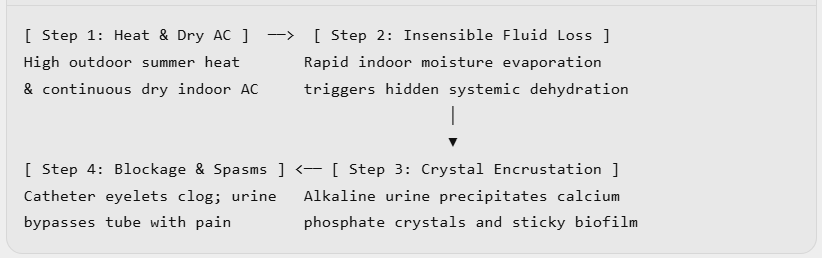
When a catheterized patient becomes mildly dehydrated:
- Urine output drops, and the remaining urine becomes concentrated, dark amber, and loaded with mineral solutes.
- Alkaline urine provides an ideal environment for bacteria such as Proteus mirabilis to produce the urease enzyme.
- This reaction crystallizes calcium and magnesium phosphates, forming hard, encrusted mineral sheets inside the catheter tube.
- These crusts block the drainage eyelets, causing sudden urine stoppage, painful bladder distension, and leakage around the sides of the catheter (bypass leakage).
The Nurse’s Dubai Hydration Rule
Unless the patient has a strict fluid restriction ordered by a nephrologist or cardiologist for heart failure or kidney disease, aim for 2 to 2.5 liters of total fluid daily.
Encourage fresh water, infused lemon water, or barley water. Avoid excessive intake of traditional black teas, strong Arabic coffee (gahwa), and carbonated soft drinks, as caffeine directly irritates the bladder lining and aggravates muscle spasms.
How Can You Prevent Catheter-Associated UTIs (CAUTI)?
Catheter-Associated Urinary Tract Infections (CAUTI) represent one of the most common complications of home catheter management. According to clinical data from the Centers for Disease Control and Prevention (CDC), the daily risk of bacterial colonization in an indwelling catheter ranges from 3% to 7% per day of catheterization.
To keep your loved one safe, healthcare professionals follow evidence-based protocols known as the CAUTI Prevention Bundle:
- Keep the System Continuously Closed: Avoid disconnecting the catheter tube from the bag except during planned bag changes. Every disconnection breaks the sterile barrier.
- Maintain Continuous Downward Gravity: Always ensure the drainage bag is positioned below the level of the hips, whether the patient is lying in bed, sitting in an armchair, or moving in a wheelchair. If the bag is raised above the bladder, contaminated urine flows back inside.
- Prevent and Manage Constipation: A rectum full of hard stool presses directly against the bladder wall and catheter tube, occluding urine flow and triggering severe bladder spasms. Ensure adequate dietary fiber, proper hydration, and consult your visiting doctor regarding safe stool softeners if needed.
- Avoid Routine Bladder Flushing: Never attempt to flush or “irrigate” the catheter at home with saline unless a physician has explicitly prescribed a sterile closed-flush protocol. Home irrigation introduces bacteria directly into the bladder.
What Should You Do If the Catheter Leaks, Bypasses, or Stops Draining?
When an issue arises, panic is common. However, many common catheter disruptions can be evaluated systematically before requiring emergency intervention.
Quick Troubleshooting Checklist
| Problem Observed | Common Root Causes | Immediate Corrective Actions |
|---|---|---|
| No urine draining into the bag for >2 hours | • Kinked or twisted tubing • Bag placed above bladder level • Catheter blocked by sediment or crystals | 1. Straighten all tubing along the leg and bed. 2. Lower the collection bag below the pelvis. 3. Gently adjust the patient’s body position. 4. If flow does not resume within 30 minutes, call a nurse. |
| Urine leaking around the outside of the tube (Bypass) | • Bladder spasms • Catheter lumen obstructed • Severe constipation | 1. Check if urine is still flowing into the bag. 2. Do not pull or push the tube. 3. If leaking continues alongside lower abdominal cramps, a nurse must assess for a blockage. |
| Pain or cramping in the lower stomach | • Bladder spasms against balloon • Urinary tract infection • Full bladder from obstruction | 1. Verify that urine is flowing freely. 2. Apply a warm compress to the lower abdomen. 3. Consult a doctor about prescribed antispasmodic medication. |
When Is Catheter Discomfort an Emergency? Red-Flag Symptoms
Some symptoms cannot wait for a routine check-up and warrant prompt medical evaluation by a licensed healthcare professional or a visiting doctor on call.
Emergency vs. Urgent Triage Classification
| Triage Level | Clinical Symptoms Observed | Recommended Immediate Action |
|---|---|---|
| Critical Emergency (Immediate medical evaluation required) | • Fever exceeding 38°C (100.4°F) with chills/rigors • Bright red bleeding or thick jelly-like clots in tubing • Catheter falls out completely • Sudden confusion, delirium, or extreme lethargy in seniors | Contact an emergency doctor or emergency service immediately. Never reinsert a dislodged catheter yourself. |
| Urgent Home Nurse Visit (Address within 1 to 2 hours) | • Zero urine output for over 2 hours despite posture checks • Persistent urine bypass leakage soaking bed linen • Cloudy, foul-smelling, or sediment-dense urine • Severe, continuous lower abdominal cramping (spasms) | Request an urgent visit from a DHA-licensed home nurse for catheter assessment, flushing, or replacement. |
- Fever and Rigors: A body temperature exceeding 38°C (100.4°F), shivers, or profuse sweating indicates that an infection may have ascended to the kidneys (pyelonephritis).
- Visible Blood or Large Clots: While light pink-tinged urine can occasionally occur after physical strain, dark red bleeding or visible clots indicate internal trauma or active inflammation.
- Acute Abdominal Pain: Severe pain, swelling, or tightness in the lower abdomen or flanks that does not improve after repositioning.
- The Catheter Falls Out: Never attempt to reinsert a displaced catheter yourself. The male and female urethral anatomy can easily be torn, false-routed, or perforated without specialized clinical equipment. Cover the meatus with a clean dressing and call a licensed nurse immediately.
- Sudden Confusion or Lethargy in Elderly Patients: In senior citizens, a serious catheter infection rarely starts with a high fever. Instead, it frequently manifests as rapid-onset confusion, agitation, disorientation, or sudden unresponsiveness classic signs of a systemic UTI.
Why Should Catheter Insertions and Replacements Be Handled by a DHA-Licensed Nurse?
Inserting or replacing a urinary catheter is a skilled, invasive medical procedure. The Dubai Health Authority (DHA) enforces stringent healthcare guidelines to protect patient safety in home settings.
Under DHA clinical regulations, catheterization requires strict Aseptic Non-Touch Technique (ANTT), sterile barrier equipment, appropriate sizing (measured in French gauge), and precise balloon inflation with sterile water to prevent urethral rupture.
Comprehensive Home Nursing with Call Doctor
Rather than subjecting an elderly or postoperative patient to the physical stress of an emergency room transfer, Call Doctor UAE delivers hospital-grade clinical care directly to your residence, hotel, or office across Dubai:
- 24/7 DHA-Licensed Medical Staff: Experienced male and female registered nurses available on demand across all Dubai communities, from Dubai Marina and Palm Jumeirah to Downtown, Arabian Ranches, and Deira.
- Sterile Procedure Compliance: Full clinical kits, medical-grade silicone catheters, closed drainage systems, and skin barrier supplies brought directly to your home.
- Caregiver Education: Nurses dedicate time during every visit to educate family members and private caregivers on bag switching, skin inspection, and daily hygiene practices.
- Integrated Medical Support: If complications like infections or painful bladder spasms arise, visiting physicians can evaluate the patient on-site, collect sterile urine samples for laboratory culture, and prescribe targeted oral or intravenous therapies.
Caregiver Daily Catheter Care Schedule
Keep your care organized by printing or saving this simple daily checklist:
| Time of Day | Step | Key Action | Why It Matters |
|---|---|---|---|
| Morning | 1 | Wash hands; clean meatal insertion site with mild soap and water front-to-back. | Clears overnight secretions and prevents bacterial entry. |
| Morning | 2 | Switch from 2L bedside night bag to daytime leg bag using alcohol wipes. | Restores mobility and comfort during daytime hours. |
| Midday | 3 | Inspect urine color; empty leg bag when 1/2 to 2/3 full. | Prevents heavy tension on the bladder neck. |
| Afternoon | 4 | Check fluid intake (ensure steady water consumption throughout the day). | Prevents Dubai climate crystal buildup and blockages. |
| Evening | 5 | Connect 2L night drainage bag; anchor below bed frame; ensure no tubing kinks. | Guarantees safe, continuous gravity drainage overnight. |
Frequently Asked Questions About Catheter Care at Home
How often does an indwelling Foley catheter need to be changed?
Standard latex catheters are typically changed every 3 to 4 weeks. High-grade 100% silicone or hydrogel-coated catheters can remain safely in place for up to 12 weeks, depending on the patient’s propensity for encrustation and the specific recommendation of their supervising physician.
Can a patient shower normally with a urinary catheter?
Yes. Showering is preferred over tub bathing because sitting in bathwater allows bacteria to pool around the insertion site. Keep the drainage bag connected and positioned below the waist while showering. Afterward, gently pat the surrounding area dry with a clean towel.
What causes urine to look cloudy or dark orange?
Dark orange or amber urine is usually a sign of dehydration, common in hot environments when fluid intake is insufficient. Cloudy urine, especially when accompanied by floating flakes, sediment, or a strong odor, often indicates an impending infection or high mineral concentration that requires clinical attention.
Can family members change a blocked catheter at home?
No. Attempting to insert or change an indwelling catheter without clinical training can cause severe urethral tearing, internal hemorrhage, false passage creation, or bladder wall perforation. Only a DHA-licensed nurse or physician should carry out catheter insertions and replacements.
How do you prevent catheter tubes from pulling during sleep?
Secure the tube to the upper thigh using a specialized stabilization strap, leaving a gentle curve of slack. Position the bedside night bag securely on a stand or bed frame below the mattress level, and ensure the tubing runs over the patient’s leg rather than trapped underneath their body weight.